Confirm the official status.
Check DeepSeek release pages, the transparency center, the API model list, model cards, pricing, and repositories. If the model ID, model card, or release page is missing, treat R2 as unconfirmed.
DeepSeek R2 guide
DeepSeek R2 is a high-interest keyword, but a reliable model decision starts with source checks. Use the K3Nova public console above to turn the search into a practical task: build a status brief, prepare a baseline test, or write a migration note that separates official DeepSeek facts from rumors. The console is available now; this page does not claim that DeepSeek R2 is launched or available as a K3Nova model route.
Start here
A model-name search becomes useful when it ends with a checkable action. DeepSeek R2 questions usually mix three things: whether there is an official release, whether current DeepSeek V4 routes already answer the need, and what evidence would justify a migration later. Keep those questions apart and your team can move without betting on a rumor.
Check DeepSeek release pages, the transparency center, the API model list, model cards, pricing, and repositories. If the model ID, model card, or release page is missing, treat R2 as unconfirmed.
Use documented DeepSeek models as the comparison point. Record model IDs, context, pricing, thinking mode, tool support, and any account or region limits before you compare outputs.
Define what would make a future R2 route worth testing: better coding output, stronger multilingual reasoning, lower cost, safer tool use, or a clearer deployment path.
Try a template
Choose a starter and it will load into the message box above. Add the specific workflow, source links, and decision audience. Then check the model ID, compare the current baseline, record the result, and update the decision note. The starters are designed to keep DeepSeek R2 research practical: one status brief, one repeatable baseline test, and one migration note for a team handoff.
Create a source-backed status brief that separates official facts, third-party tracking, rumors, and next checks.
Design a stable evaluation pack so a future R2 result can be judged against the same real workload.
Turn model curiosity into a migration note with access, cost, privacy, test, fallback, and approval checks.
Useful DeepSeek R2 work should leave a short trail: what official sources show, what current models are documented, what task you tested, what evidence is missing, and what the next decision should be. K3Nova is strongest when that trail stays attached to the conversation.
Return to the console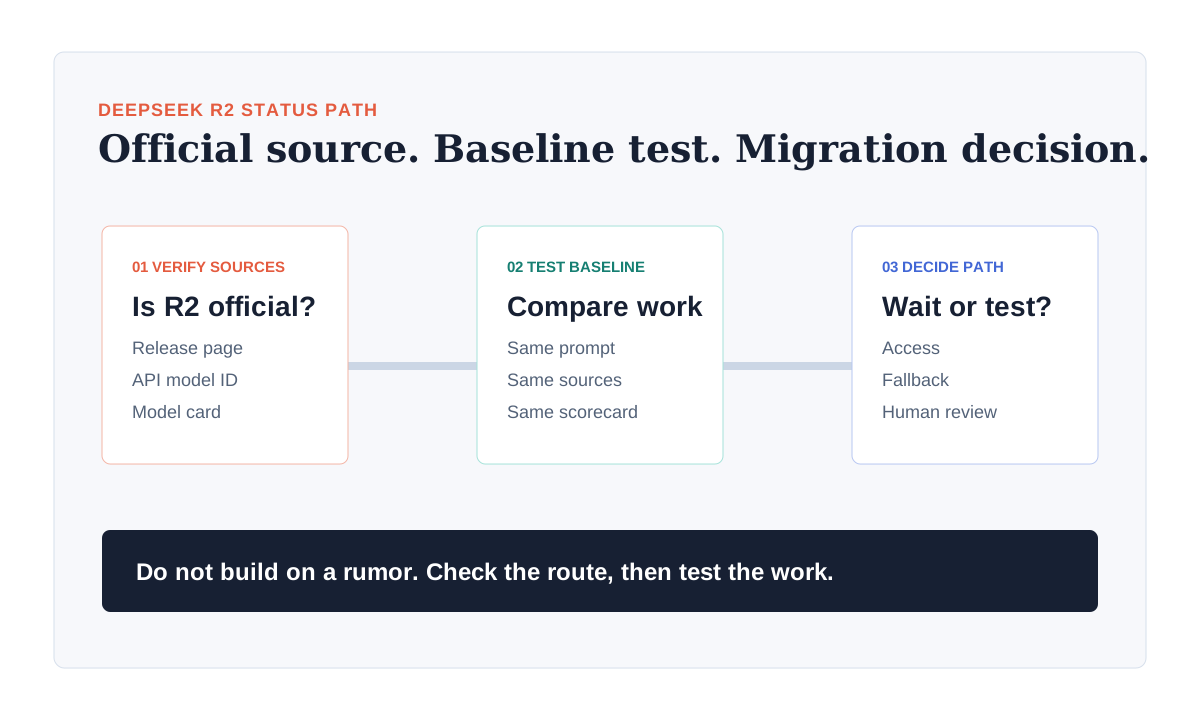
Status checks
These checks are deliberately narrow. They help a reader decide what can be said today and what must wait for an official DeepSeek source.
| Official release | Use DeepSeek's transparency center and release notes first. The checked official sources list released DeepSeek models, including V4, but do not provide a DeepSeek R2 launch page. |
|---|---|
| API route | Use the model list and chat-completion docs for exact model IDs. The checked docs show current V4 model values, not a DeepSeek R2 API value. |
| Pricing and limits | Use DeepSeek's pricing page for documented models only. Do not infer R2 token prices, context, output limits, or concurrency from unrelated models. |
| Open weights | Use model cards, Hugging Face collections, and the official GitHub organization to confirm public artifacts before planning deployment or fine-tuning work. |
Before you switch
A future R2 launch would still need a practical comparison. Prepare the comparison now, then rerun it only when a source-backed model route exists.
Questions
Use the console for a real work artifact, and use the source links below for volatile model facts. That keeps a DeepSeek R2 search useful without turning speculation into product copy.
DeepSeek R2 is not listed in the K3Nova model picker. This page opens the shared K3Nova public console so you can build a status brief, baseline test, or migration note while keeping R2 availability separate from the task.
Official DeepSeek sources checked for this page show released DeepSeek models and current V4 API routes, but they do not show a DeepSeek R2 model card, API model ID, or release page.
Start with DeepSeek's transparency page, API model list, pricing page, chat-completion docs, model cards, and official repositories. Treat social posts and screenshots as leads to check, not as release evidence.
The official DeepSeek material used for this page points to DeepSeek-V4-Pro and DeepSeek-V4-Flash as current documented API models. Use those sources for model IDs, pricing, context, and feature checks.
Keep a small evaluation pack: one real task, source material, expected output, scoring notes, privacy boundary, and fallback rule. If R2 appears officially, rerun the same pack instead of changing every variable at once.
The console can help you write the brief, compare source facts, prepare prompts, and record a decision. It should not be read as proof that K3Nova is routing requests to DeepSeek R2.