Check the path.
Check official documentation for the model id, access surface, context limits, pricing, and release notes before you treat GLM 5.5 as available.
GLM 5.5 guide
Use this page to turn a GLM 5.5 search into a practical adoption brief. The live K3Nova public console starts on GLM 5.2 through OpenRouter, while the GLM 5.5 route itself should still be checked against official Z.ai sources before you depend on it. Start with what you need to know: whether there is an official model id, whether pricing and access match your workload, which baseline should be compared, and what would make a switch worth it. That keeps the page useful even when model news is moving faster than your production checklist.
Start here
A model-name search becomes useful when it ends in a concrete decision. Use the console to record what is officially confirmed, what still needs checking, and what test would prove that a future GLM 5.5 route helps your actual work. The goal is not to rank every model in the abstract. It is to decide whether a specific workflow should stay where it is, run a side-by-side trial, or wait for clearer release and pricing evidence.
Check official documentation for the model id, access surface, context limits, pricing, and release notes before you treat GLM 5.5 as available.
Compare against a current GLM-family route using the same prompt, source bundle, output format, scoring notes, and fallback condition.
Define what would justify a switch: better constraint handling, lower cost, faster turnaround, stronger code output, or clearer compliance fit.
Try a template
Choose a starting point and it will appear in the message box above. Add the current source links, your workload, and the decision you need to make. The templates are designed for GLM 5.5 monitoring, not generic chat: one creates a source-backed status brief, one designs a baseline test, and one turns the result into a migration checklist you can share.
Create a GLM 5.5 status brief that separates official facts, assumptions, open questions, and next checks.
Design a repeatable GLM-family baseline test so a future GLM 5.5 result can be judged against the same task.
Draft a GLM 5.5 migration checklist with access, pricing, privacy, evaluation, fallback, and handoff checks.
GLM 5.5 research is easiest to use when the evidence and the evaluation live next to each other. Keep official docs, pricing checks, model-card notes, baseline prompts, and the final adoption rule in one brief so your next action is clear.
Return to the console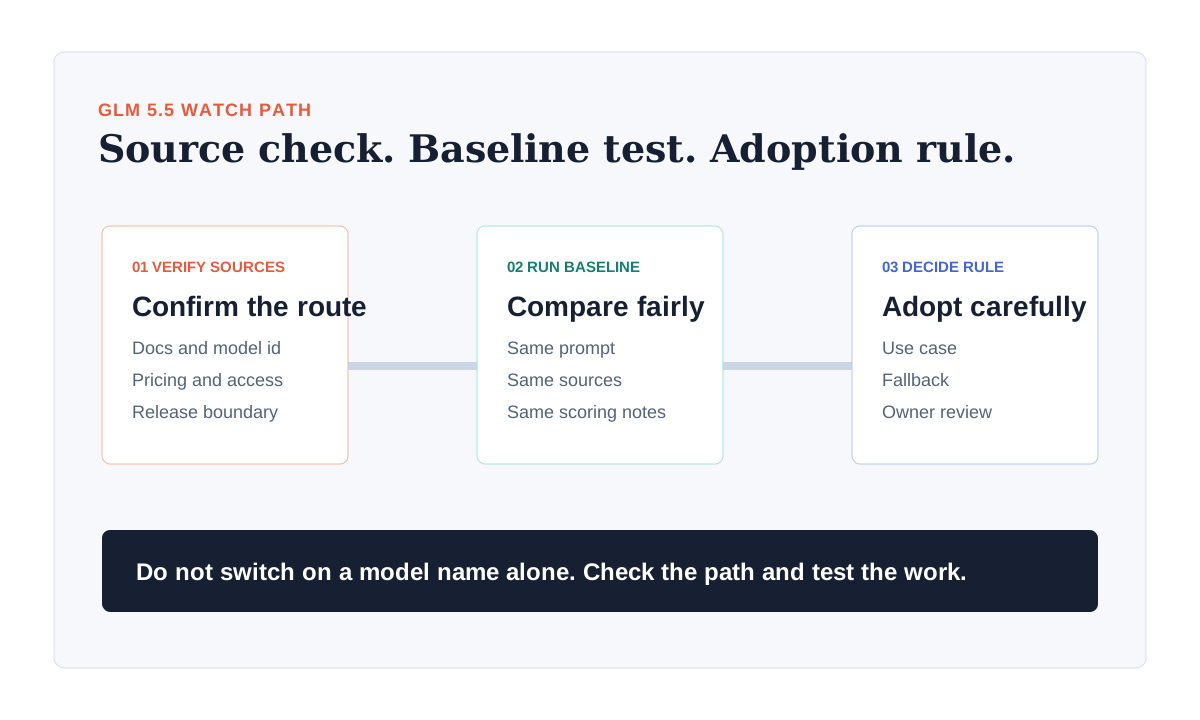
A focused session
Use one short session to move from a search result to a usable working note. The goal is a decision artifact you can update when official GLM information changes.
Paste the Z.ai documentation links, the latest visible model-card notes, and any current pricing or access page. Ask the console to mark which facts are confirmed and which are still assumptions.
Name one workload that matters: code review, long-context research, Chinese-English writing, tool planning, or structured extraction. Keep the same input and scoring notes for every route.
Write what would trigger a trial, what would block production use, and what fallback keeps work moving if the GLM 5.5 route is not ready.
Before you switch
Model adoption is a workflow decision, not only a headline decision. Before routing important work to GLM 5.5, confirm the route, test the task, and decide who owns the final review.
Questions
Use the console for source-backed notes, not unsupported claims. If your GLM 5.5 question is about current product information, start with the official and upstream sources below.
GLM 5.5 is not listed in the K3Nova model picker. The public console opens with GLM 5.2 through OpenRouter, so you can plan, test, and document the work while you keep GLM 5.5 claims separate from official release evidence.
This page treats GLM 5.5 as a monitoring keyword. Check Z.ai documentation before assuming that a GLM 5.5 model id, API route, pricing table, or release date is available.
Use a current GLM-family baseline, the same prompt, the same source material, and the same output format. Then judge reliability, constraint handling, latency, cost, and whether the result can be repeated.
Yes. Describe the system, paste relevant context, and ask for a test plan, code review, migration note, or rollout checklist. Check important facts against official sources before production use.
Start with Z.ai documentation, pricing, model cards, GitHub issues, and community discussions. Treat social posts and screenshots as leads to verify, not as release evidence.