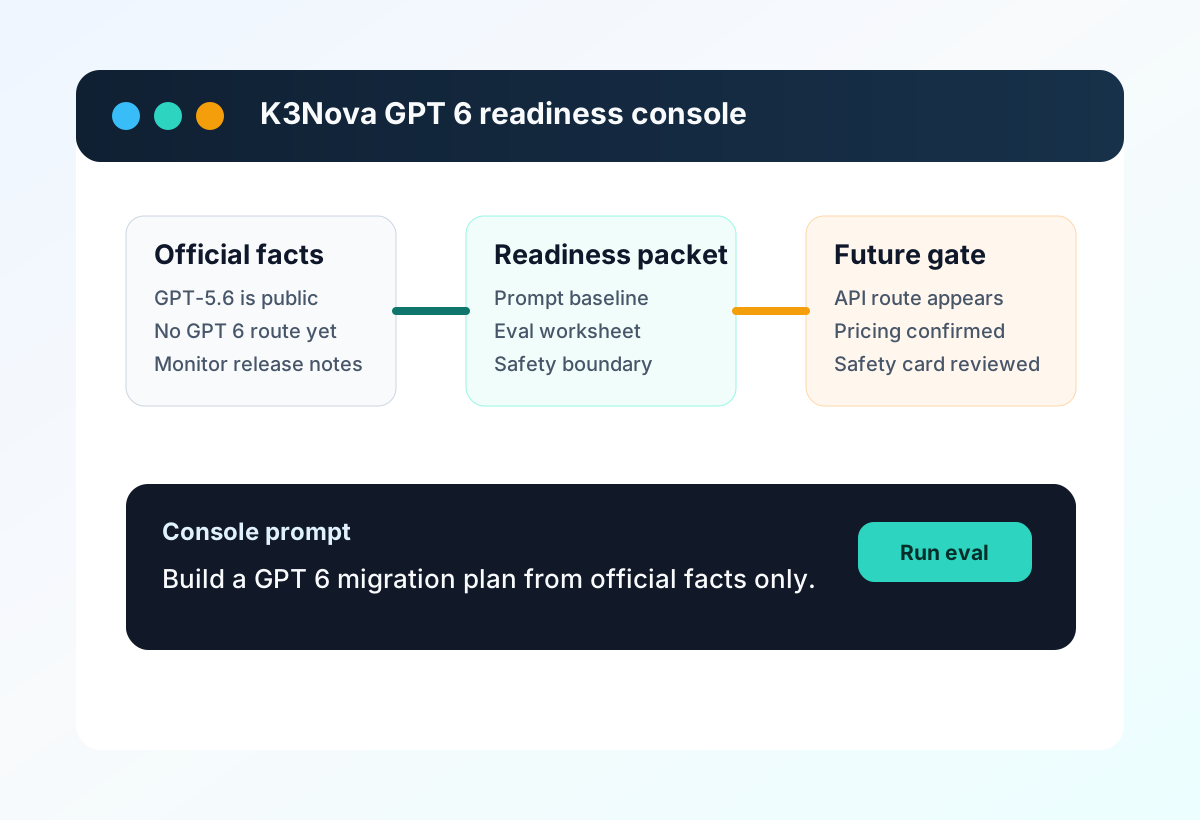
GPT 6 readiness guide
GPT 6 readiness in the K3Nova public console
GPT 6 is the right keyword for many teams planning the next model jump, but the public materials reviewed for this guide do not confirm a GPT 6 route, release date, pricing sheet, context window, or availability contract. Treat this page as a workspace for preparation, not a launch announcement.
Short answer: GPT 6 is not a confirmed public route today. K3Nova can still help you build the prompts, evaluation packet, safety checks, and fallback decisions you will want ready before an official GPT 6 path appears.
Readiness board
What to do before GPT 6 has official public facts
A useful GPT 6 readiness plan starts with separation. Current-state facts belong in one lane, GPT 6 assumptions belong in another lane, and launch-day acceptance checks belong in a third. K3Nova is good at this kind of structured preparation because the public console can turn a fuzzy model rumor into prompts, worksheets, and repeatable review steps.
Collect real tasks you would actually route to a future frontier model: coding diffs, long research briefs, product specs, data interpretation, support escalations, and agent plans. Save the current best answer from your existing route so you have something to compare later.
Monitor OpenAI release notes, API documentation, system cards, and pricing pages for GPT 6 signals. Community discussion can reveal what readers care about, but it should not decide whether GPT 6 exists, what it costs, or where it is available.
Define the minimum improvement needed before switching. A GPT 6 route might need better instruction following, lower correction time, stronger tool discipline, safer agent behavior, or better long-context recall. Write those checks before seeing the new model.
When an official route appears, test it against current routes instead of assuming the newest model wins. Keep a stable fallback for cost spikes, rate limits, regional availability, safety concerns, or task types where another model remains stronger.
Build a GPT 6 readiness packet from official facts only. Separate confirmed facts from assumptions, create five representative evaluation tasks, define pass/fail criteria, and recommend a fallback route if GPT 6 is not available.
Current facts
The source-backed facts that shape this page
The practical answer is conservative because the public record is conservative. OpenAI has published GPT-5.6 materials and release notes, and it has discussed an unnamed more capable pre-release model in a security disclosure. Those facts do not equal a GPT 6 launch. K3Nova's role is to help you prepare the work you will run when official GPT 6 details become available.
OpenAI's GPT-5.6 launch page is the current public anchor for GPT-family capability, availability, and pricing details. It names GPT-5.6 Sol, Terra, and Luna, not GPT 6.
Read the GPT-5.6 launch pageThe model release notes are where readers should check availability by plan and surface. They support careful wording because model access can change over time.
Read OpenAI model release notesThe GPT-5.6 System Card makes safety and agent behavior part of the evaluation story. A future GPT 6 adoption decision should include the same discipline.
Read the GPT-5.6 System CardOpenAI's evaluation-incident disclosure mentions an unnamed more capable pre-release model. The page does not identify that model as GPT 6, so this guide does not either.
Read the evaluation incident disclosureHacker News discussion around the incident shows how technical readers scrutinize model evaluation and trust. It is useful context, not a source of release facts.
Read the Hacker News discussionOpenAI Developer Community discussion about rapid iteration reinforces why a readiness page should focus on evaluation packets, maturity checks, and fallback rules.
Read the community discussionK3Nova homepage OpenAI GPT-5.6 launch page OpenAI model release notes GPT-5.6 System Card OpenAI and Hugging Face evaluation incident Hacker News discussion OpenAI Developer Community discussion
Console workflow
Use K3Nova to turn GPT 6 curiosity into a real migration packet
The public console is most useful when you give it a bounded job. Instead of asking whether GPT 6 will be better in the abstract, ask it to create the material your team will need later: a GPT 6 test set, a GPT 6 review rubric, a risk checklist, and a decision memo. That packet becomes reusable the moment official GPT 6 details appear.
Write five to ten representative prompts from your real workflow. Include one short task, one long-context task, one tool-heavy task, one ambiguous instruction, and one safety-sensitive scenario.
Define what a strong answer should preserve: facts, reasoning trace, citations, code behavior, formatting, privacy boundary, or final decision quality. The check should be visible and repeatable.
Write what the model must refuse, slow down, or escalate. For agentic work, include tool limits, private-data handling, write permissions, and review points before external actions.
Choose the current route that remains acceptable if GPT 6 is unavailable, too expensive, region-limited, or weaker on a specific task. A good migration plan always has a return path.
Migration worksheet
A practical GPT 6 switch should pass these gates
Future-model adoption gets messy when the team only asks whether a model feels smarter. Use explicit gates instead. Each row below can become a K3Nova task, a spreadsheet column, or a release checklist.
| Gate | What to confirm | Why it matters | Fallback if it fails |
|---|---|---|---|
| Official route | API model name, ChatGPT surface, region, account tier, and rate limits. | A model cannot be a production route until availability is explicit. | Keep current K3Nova routing and mark GPT 6 as watch-only. |
| Quality lift | Better results on your own prompt packet, with fewer corrections by the reviewer. | Benchmarks help, but your workflow decides the migration. | Use GPT 6 only for the task types where it wins. |
| Safety posture | System-card review, refusal behavior, tool discipline, and private-data boundary. | A stronger model can still be wrong for sensitive agent workflows. | Route sensitive work to a reviewed model with stricter controls. |
| Cost and latency | Input price, output price, cache behavior, latency, and quota behavior. | A better answer can be a worse product choice if it breaks the operating budget. | Reserve GPT 6 for high-leverage jobs and keep cheaper routes for routine tasks. |
Prompt starters
Prompts to run in the public console
These prompts are written for GPT 6 preparation. They ask K3Nova to organize current facts and future GPT 6 tests without inventing specifications.
Track official model release notes and summarize only confirmed changes related to GPT 6. Separate launch facts, pricing facts, safety facts, and unsupported claims.
Turn these five production prompts into a GPT 6 evaluation packet. Preserve original intent, define expected answer traits, and add reviewer scoring notes.
Draft a one-page migration memo that compares current routing with a future GPT 6 route. Include adoption gates, known unknowns, fallback rules, and a decision owner.
Claim boundary
What this GPT 6 page does not claim
The safest GPT 6 future-model page is useful precisely because it refuses to turn speculation into product copy. Until official materials say otherwise, keep these claims out of your internal docs, release notes, and public marketing.
- No GPT 6 release date is confirmed by the sources checked for this page.
- No GPT 6 API model name, endpoint, price, rate limit, or context window is confirmed here.
- An unnamed pre-release model in an evaluation disclosure should not be renamed as GPT 6.
- Community discussions can explain reader concerns, but they do not establish availability or capability claims.
- A migration should wait for official route, safety, pricing, and availability details, then pass your own task-based evaluation.
FAQ
GPT 6 readiness questions
Is GPT 6 available in K3Nova today?
No. The public materials checked for this page did not include an official GPT 6 route, release date, pricing sheet, context window, or availability contract. K3Nova can still help you prepare prompts, tests, and migration rules while you wait for official facts.
Why build a GPT 6 page before an official launch?
Teams usually need evaluation prompts, baseline tasks, privacy boundaries, and fallback rules before a new flagship model appears. Preparing those assets early makes the launch-day decision calmer and more evidence based.
What should I monitor for GPT 6?
Watch official OpenAI release notes, API documentation, safety cards, pricing pages, and availability notes. Treat forum or social discussion as helpful context, not as a source of release facts.
Can an unnamed pre-release model be treated as GPT 6?
No. OpenAI has referenced an unnamed more capable pre-release model in a security disclosure, but that does not make it GPT 6. This page keeps that distinction explicit.
What should a GPT 6 migration test include?
Include a representative prompt packet, expected answer traits, tool-use constraints, data-handling rules, latency and cost checks, safety review, and a fallback route if the future model is unavailable or unsuitable.
Next reads
Model guides that pair well with GPT 6 planning
Use these pages to compare current routes while the GPT 6 facts are still incomplete.