 K3Nova
Benchmark bench
Opus 5 coding benchmark
Benchmark the patch that survives review.
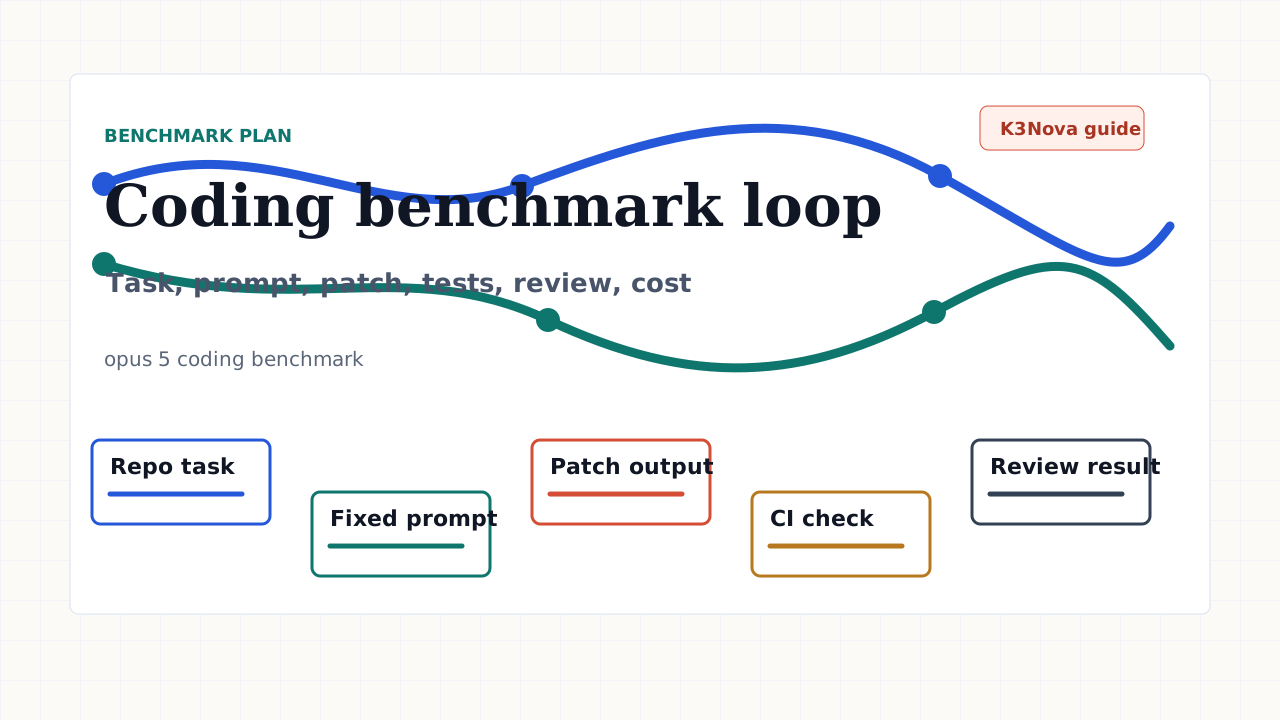
Repo task
Fixed prompt
Patch output
CI check
Review result
Read
Opus 5 coding benchmark: what should you decide first?
A useful Opus 5 coding benchmark should feel like an engineering review, not a leaderboard screenshot. The public material says Opus 5 is worth testing for coding and agent work; the benchmark should show whether it helps your repository.
Benchmark Opus 5 with real tasks, fixed prompts, captured outputs, test commands, human review, and cost notes. The strongest result is not a high score. It is a patch or review comment that survives the same scrutiny as human code.
Choose benchmark tasks from your backlog
Pick tasks that engineers already recognize: a failing test, a refactor with clear boundaries, a dependency upgrade, a security hardening pass, or a bug with enough surrounding context. Avoid artificial prompts that do not resemble your codebase. A benchmark is useful only if the result changes an engineering decision.
Freeze the prompt and acceptance criteria
Give each run the same files, same branch state, same constraints, and same output format. Ask for a short plan, then a patch or review notes, then tests. Keep the prompt in a private record so later model runs can be compared without changing the task.
Score after review
Have a human reviewer classify the output: accepted, accepted with edits, useful but not shippable, or rejected. Record missed risks, hallucinated APIs, broad refactors, and test failures. This produces evidence you can act on rather than a vague impression.
Use external benchmarks as context
Artificial Analysis and CodeRabbit can help calibrate expectations, but your benchmark should decide whether Opus 5 helps your product. Use official docs for limits and price anchors, then let your repository decide the adoption rule.
Check
Use these Opus 5 coding benchmark checks before you rely on the route.
The page is useful only when it turns a model name into a test a person can actually check.
A real issue, test failure, migration, or review question.
Fixed source set, constraints, and output format.
Diff, tests, reviewer notes, and model answer.
Accepted result, repair loops, latency, and token cost.
Signals
Keep Opus 5 coding benchmark signals close to the decision.
These notes keep source facts, review signals, and practical limits separate so the page stays useful instead of broad.
Pair official Opus docs with independent code-focused reviews.
Accepted diffs and useful review comments matter more than one-off examples.
Output-heavy code answers can change the budget.
Method
How should you use this Opus 5 coding benchmark page?
Read it as a compact working note. The goal is to leave with a testable next step, a clear route boundary, and the checks that keep the result honest.
- Name the task behind opus 5 coding benchmark before comparing model names.
- Write down the source material, output format, review bar, and the decision you need to make.
- Check the provider route, current limits, and price rules before using the result for production work.
- Run one realistic prompt and judge the answer after a human reviews the output.
- Turn a repeated win into a narrow routing rule, not a universal model preference.
Limits
What should stay visible before serious use?
The model name is only the start. Availability, route behavior, context limits, output size, and price rules must match the account that will actually run the task.
Anthropic introduced Claude Opus 5 on July 24, 2026.
Anthropic documentation lists the model ID as claude-opus-5.
Anthropic documentation lists a 1M token context window and 128K maximum output.
Adaptive thinking is the default, while Fast mode is available when latency matters.
Anthropic documentation lists Opus 5 at $5 per million input tokens and $25 per million output tokens; cache and platform rules should be checked before final budgeting.
Review
What counts as a good result?
A useful page does not make the model choice sound grand. It helps a person reduce uncertainty, run a fair test, and reject weak output early.
The answer improves the exact job on the page, not a generic model comparison.
Important names, limits, dates, prices, and caveats stay attached to the source that supports them.
A person can check the result without asking for a long repair conversation.
The page ends with a decision that can become a workflow rule.
Sensitive legal, security, payment, privacy, and deployment decisions still have a human owner.
Sources
References used for this guide
Use these links to refresh exact model details, availability, pricing, and review context before a serious rollout.
- Anthropic Docs: What is new in Claude Opus 5Model ID, 1M context, 128K max output, adaptive thinking, Fast mode, and migration notes.
- Anthropic Docs: prompting Claude Opus 5Prompting habits for longer answers, code review, self-checking, and agent work.
- CodeRabbit Opus 5 model reviewCode-review focused practical evaluation and workflow observations.
- Artificial Analysis model pageIndependent comparison signals for intelligence, cost, speed, and verbosity.
- Anthropic launch announcementLaunch date, positioning, benchmark framing, pricing context, and system-card path.
FAQ
Common follow-up questions
What is the best Opus 5 coding benchmark?
A real repository task with a fixed prompt, test command, human review, and cost record.
Should I use public leaderboards?
Use them as context, not as your final adoption decision.
What is a passing result?
A result that a reviewer accepts or can use with limited edits, plus a clear reduction in repair loops.
Next
Continue with the closest next question.
Move from the broad route decision to the exact constraint: code, context, price, reasoning, release timing, or review quality.