 K3Nova
Release line
Opus 5 release date
Use the launch date to check availability, not to skip review.
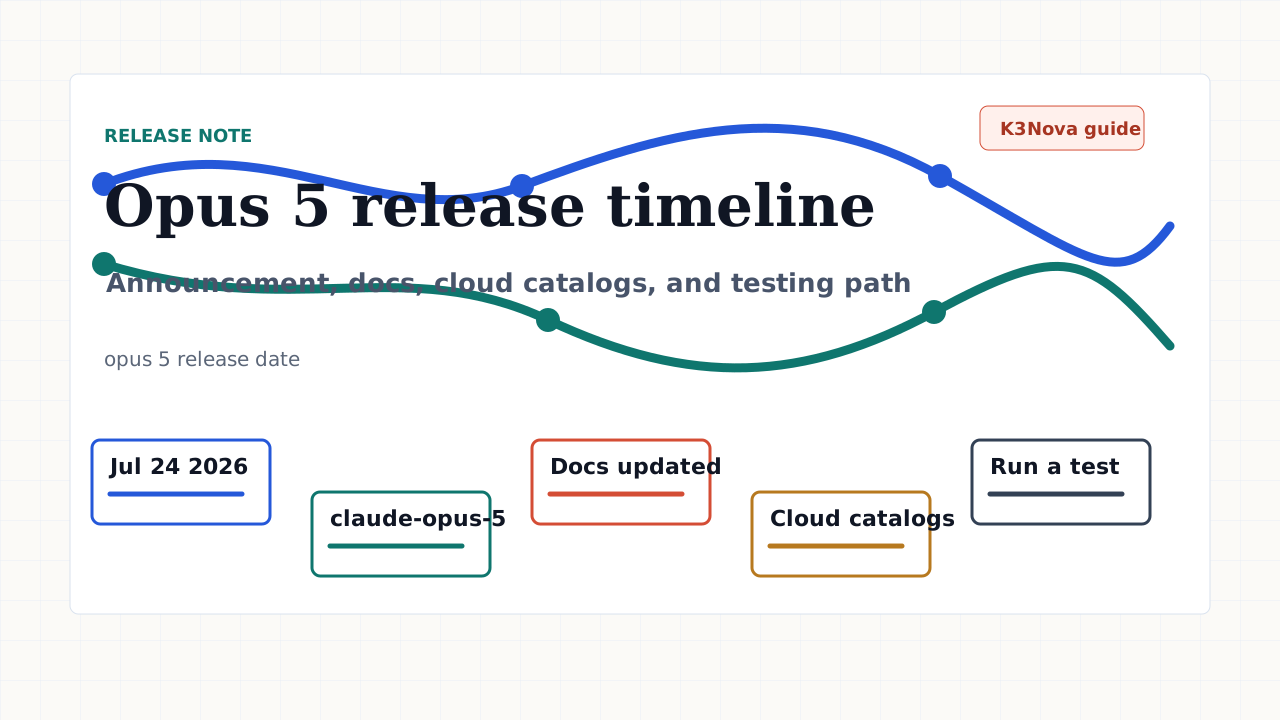
Jul 24 2026
claude-opus-5
Docs updated
Cloud catalogs
Run a test
Read
Opus 5 release date: what should you decide first?
Claude Opus 5 was introduced by Anthropic on July 24, 2026. The release material points to a new Opus model with long context, adaptive thinking, Fast mode, coding and agent positioning, and cloud availability paths through major platforms.
Use July 24, 2026 as the launch-date anchor, then check the provider path you plan to use. Availability can differ across Anthropic direct API, AWS Bedrock, Google Cloud, Microsoft Foundry, and account-specific model access.
What was released
The gathered material describes Claude Opus 5 as a new Opus-class model focused on difficult reasoning, coding, agent work, and long-context tasks. The docs list the model ID, context and output limits, thinking behavior, and migration notes. That combination gives builders enough to begin a controlled evaluation.
Where to check availability
Start with the Anthropic launch page and docs if you use Anthropic directly. If your organization routes models through cloud platforms, check AWS Bedrock, Google Cloud, and Microsoft Foundry pages as well. Those pages help determine whether your account, region, and platform features support the model.
What changed for builders
The release matters most when a workflow was constrained by context size, careful reasoning, or code-review depth. Opus 5 does not remove the need for good prompts, test commands, source labeling, or safety review. It gives you a stronger candidate for tasks where those controls already exist.
How to check your path
Before moving production work, make one small test call, confirm the model name, run a known prompt, and compare the answer against a previous baseline. Keep a note of latency, output length, and whether the answer required extra repair prompts.
Check
Use these Opus 5 release date checks before you rely on the route.
The page is useful only when it turns a model name into a test a person can actually check.
Use July 24, 2026 as the announcement anchor.
Confirm model access and documentation in your Anthropic account.
Check your cloud platform catalog and region support.
Run a known task before moving production traffic.
Signals
Keep Opus 5 release date signals close to the decision.
These notes keep source facts, review signals, and practical limits separate so the page stays useful instead of broad.
Anthropic's launch announcement is dated July 24, 2026.
The Anthropic docs identify the model as claude-opus-5.
AWS, Google Cloud, and Microsoft materials provide cloud-platform context.
Method
How should you use this Opus 5 release date page?
Read it as a compact working note. The goal is to leave with a testable next step, a clear route boundary, and the checks that keep the result honest.
- Name the task behind opus 5 release date before comparing model names.
- Write down the source material, output format, review bar, and the decision you need to make.
- Check the provider route, current limits, and price rules before using the result for production work.
- Run one realistic prompt and judge the answer after a human reviews the output.
- Turn a repeated win into a narrow routing rule, not a universal model preference.
Limits
What should stay visible before serious use?
The model name is only the start. Availability, route behavior, context limits, output size, and price rules must match the account that will actually run the task.
Anthropic introduced Claude Opus 5 on July 24, 2026.
Anthropic documentation lists the model ID as claude-opus-5.
Anthropic documentation lists a 1M token context window and 128K maximum output.
Adaptive thinking is the default, while Fast mode is available when latency matters.
Anthropic documentation lists Opus 5 at $5 per million input tokens and $25 per million output tokens; cache and platform rules should be checked before final budgeting.
Review
What counts as a good result?
A useful page does not make the model choice sound grand. It helps a person reduce uncertainty, run a fair test, and reject weak output early.
The answer improves the exact job on the page, not a generic model comparison.
Important names, limits, dates, prices, and caveats stay attached to the source that supports them.
A person can check the result without asking for a long repair conversation.
The page ends with a decision that can become a workflow rule.
Sensitive legal, security, payment, privacy, and deployment decisions still have a human owner.
Sources
References used for this guide
Use these links to refresh exact model details, availability, pricing, and review context before a serious rollout.
- Anthropic launch announcementLaunch date, positioning, benchmark framing, pricing context, and system-card path.
- Anthropic Docs: What is new in Claude Opus 5Model ID, 1M context, 128K max output, adaptive thinking, Fast mode, and migration notes.
- AWS Bedrock announcementCloud deployment availability and Bedrock integration context.
- Google Cloud model cardPartner-model availability, platform limits, regions, and feature support.
- Microsoft Foundry pageAzure availability and deployment context for enterprise planning.
- TechCrunch launch coverageMarket framing and product-availability context.
- The Verge launch coverageConsumer-facing product coverage and release context.
FAQ
Common follow-up questions
When was Opus 5 released?
Anthropic introduced Claude Opus 5 on July 24, 2026.
What model name should I look for?
Check Anthropic documentation for claude-opus-5.
Does release mean every platform has it?
No. Check your direct API or cloud-platform catalog because availability can vary by platform, account, and region.
Next
Continue with the closest next question.
Move from the broad route decision to the exact constraint: code, context, price, reasoning, release timing, or review quality.